



Schengen visa photo size: rules for applicants from India and Nigeria
The Schengen photo format, what the German missions in India and Nigeria ask for, how it differs from your Indian passport photo, and the mistakes that cost a second trip.
Contents
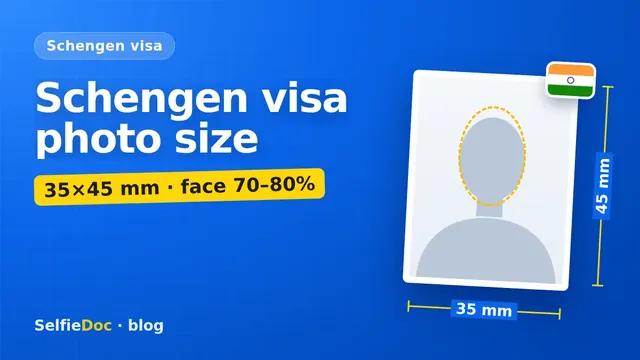
A Schengen visa photo is 35×45 mm (3.5×4.5 cm), in colour, on a white background, taken within the last six months, with the face covering 70–80% of the frame. EU rules say the photo must follow the ICAO standard, and each country's mission sets the details. The German missions in India ask for at least one such photo; the German missions in Nigeria ask for two, not glued or stapled to the form. Your fingerprints are taken at the appointment, but you still hand in printed photos. You can make the photo online from a good selfie in SelfieDoc: the service fits the size, background and head position to the requirements.
Schengen visa photo requirements
| Parameter | Requirement | Source |
|---|---|---|
| Standard | photo in line with ICAO Doc 9303 | EU Visa Code, Article 13 |
| Size | 35×45 mm | German missions in India and Nigeria |
| Face | 70–80% of the photo (about 31.5–36 mm chin to crown) | German missions in India |
| Background | white, uniform | German missions in India and Nigeria |
| Age of photo | not older than six months | German missions in India and Nigeria |
| Number (Germany, India) | minimum one | Germany tourism checklist, India |
| Number (Germany, Nigeria) | two, not glued or stapled to the form | Germany tourist visa page, Nigeria |
| Fingerprints | taken at the appointment; not needed under 12, or if given within the last 59 months (with exceptions) | EU Visa Code; Netherlands Worldwide |
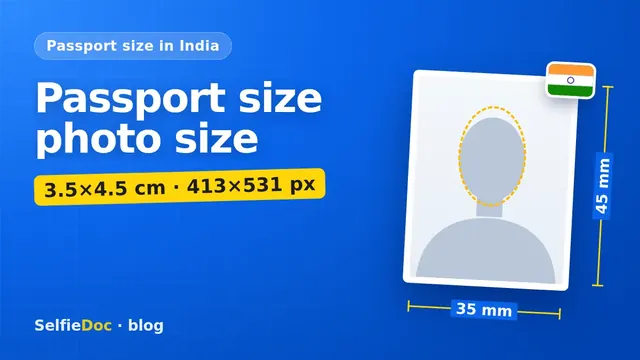
| In pixels | 413×531 px at 300 dpi (calculation, for printing) | — |
Checked: October 2026 against the German missions' websites in India and Nigeria and the EU Visa Code.
Where the rules come from
The Schengen Visa Code (Regulation 810/2009) says the photo collected with your application must meet the ICAO standard, the international rules for passport photos. It doesn't print a size in millimetres. The exact format, the number of photos and the background colour come from the checklist of the country you apply to.
35×45 mm is the usual Schengen format. Germany is a good example because both of its networks publish clear lists:
- India: "Min. 1 biometric passport picture (35x45mm white background, 70%-80% face coverage), not older than six months."
- Nigeria: two biometric photographs, not older than six months, uniform white background, 3.5×4.5 cm, not glued or stapled to the application form.
If you're going to France, Italy, the Netherlands or another country, open that country's checklist on the mission or visa centre website before you print. Requirements can differ in small ways, such as the number of photos.
Is a Schengen photo the same as an Indian passport photo?
The size can be the same, but the rules aren't.
| Schengen visa (Germany, India) | Indian passport, paper form | Indian passport, upload from abroad | |
|---|---|---|---|
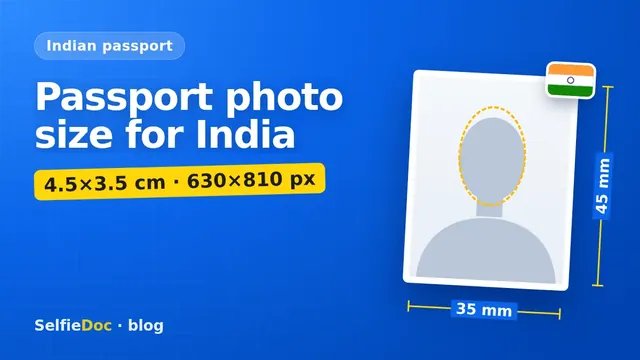
| Size | 35×45 mm | 4.5×3.5 cm | 630×810 px |
| Face | 70–80% of the photo | not specified | 80–85% |
| Background | white | plain white | white |
| Age | not older than six months | recent | — |
So a recent 35×45 mm print from your Indian passport application may work, provided the face isn't too large. For the Indian side of the story, see our Indian passport photo size guide.
What doesn't work is the square 2×2 inch (51×51 mm) photo used for US visas. It's a different shape, and cutting it down usually leaves the head too big for the frame.
How big should the head be?
The German missions in India give 70–80% face coverage. On a 45 mm photo, that's roughly 31.5 to 36 mm from the bottom of the chin to the top of the head. In practice:
- leave a little space above the hair;
- show the top of the shoulders;
- keep the head straight and centred, looking into the camera.
A close crop where the hair touches the top edge goes over 80%. A photo taken from too far away, where the head is a small oval in the middle, falls under 70%.
Applying from India: VFS and fingerprints
Many Schengen countries take applications in India through visa application centres such as VFS Global. Germany's checklist refers to submitting your application via a VFS application centre, and the Netherlands asks you to appear in person at a VFS centre and give fingerprints.
Fingerprints don't replace the photo. Under the Visa Code, children under 12 are exempt from fingerprinting, and fingerprints first entered in the Visa Information System less than 59 months before your new application are normally copied to it. The consulate can still take them again if there is doubt about your identity. Bring printed photos in any case.
Applying from Nigeria: Lagos and Abuja
For Germany, the Consulate General in Lagos is responsible for visa applications as a rule; some applications can be submitted at the embassy in Abuja. You book an appointment yourself (it's free), appear in person, and your fingerprints are taken at the interview. Bring two 35×45 mm photos on a white background, loose rather than glued to the form. The visa fee is 90 euros, payable in naira at the mission's exchange rate.
Other Schengen countries in Nigeria use their own appointment systems and checklists. Check the photo line on the list for your destination.
Common Schengen photo mistakes
- A 2×2 inch square photo instead of 35×45 mm.
- Face too big or too small. Stay within 70–80%.
- A grey, cream or blue background. Both German missions ask for white.
- An old photo. Six months is the limit on both German lists.
- Gluing the photos to the form when the Nigeria checklist says not to.
- One photo when the checklist says two, or the other way round. Count against your country's list.
- Glasses with glare or a tinted lens. The ICAO standard requires clearly visible eyes; taking glasses off is the simplest fix.
How to get a Schengen visa photo
At a photo studio. Say "Schengen visa, 35×45 mm, white background" rather than "passport size", so you don't get a 2×2 inch print. Check the head size against the 31.5–36 mm range.
At home. Stand in front of a plain white wall, face a window in daylight and have someone take the picture at eye level from a metre or two. Print at 100% scale on photo paper, not on plain paper.
Online from a selfie. SelfieDoc crops the photo to 35×45 mm, sets the head size and position, and checks the size and background before you get the file. Your facial features stay as they are. Print the sheet at a photo lab.
For a side-by-side table of the photo formats used in India, see our passport size photo dimensions guide.
Sources
- Federal Foreign Office, German Missions in India: checklist for a Schengen visa for tourism.
- Federal Foreign Office, German Missions in Nigeria: tourist visa and Schengen visa procedure.
- Netherlands Worldwide: applying for a Schengen visa in India.
- EU Visa Code, Regulation (EC) No 810/2009, consolidated text: Article 13, biometric identifiers.
- European Commission: visa policy.
FAQ
What is the Schengen visa photo size in cm?
3.5×4.5 cm, that is 35 mm wide and 45 mm high. The German missions in India add that the face should cover 70–80% of the photo, which means a head of about 31.5–36 mm from chin to crown.
Can I use my Indian passport photo for a Schengen visa?
Only if it is a 35×45 mm print on a white background, less than six months old, with the face filling 70–80% of the frame. A square 2×2 inch photo won't do.
How many photos do I need for a Schengen visa?
It depends on the country and mission. The German missions in India ask for at least one; the German missions in Nigeria ask for two. Follow the checklist for your destination country.
Do I need a photo if biometrics are taken at VFS?
Yes. Fingerprints are taken at the appointment, but the checklists still ask for printed biometric photos to be handed in with the application.
Can I make a Schengen visa photo online?
Yes. SelfieDoc crops a selfie to 35×45 mm, sets the head size and checks size and background without changing your face. You get a file and a sheet to print on photo paper.
Comments
Only registered users can comment
Sign in to commentSign in with the same account you use for SelfieDoc.
No comments yet. Be the first to ask a question, and we’ll answer.