



What to wear for a passport photo
The State Department bans only a few items for passport photos. Here is that list, plus practical advice on colors, suits and head coverings, so your photo looks right the first time.
Contents
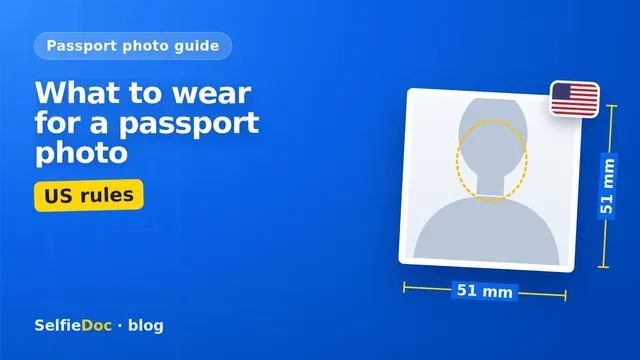
For a US passport photo, wear plain everyday clothes. The State Department's photo page names these items you can't wear: uniforms, clothing that looks like a uniform, camouflage, hats or head coverings without an approved exception, headphones, and glasses. You need one 2 × 2 in (51 × 51 mm) color photo on a plain white or off-white background, taken within the last 6 months. You can make one online from a good selfie in SelfieDoc.
What the passport photo rules say about clothing
The pages we reviewed list only the items below and set no other clothing requirements, so colors, suits and casual tops are your choice.
| Parameter | Requirement | Source |
|---|---|---|
| Uniform | No uniform and no clothing that looks like a uniform | travel.state.gov — U.S. Passport Photos |
| Camouflage | Camouflage clothing is not allowed | travel.state.gov — U.S. Passport Photos |
| Hats and head coverings | Take them off | travel.state.gov — U.S. Passport Photos |
| Religious head covering | Allowed with a signed statement that it's religious attire worn daily in public | travel.state.gov — U.S. Passport Photos |
| Medical head covering | Allowed with a signed doctor's statement that it's worn for medical purposes | travel.state.gov — U.S. Passport Photos |
| Face with head covering | Full face visible, no shadows or covered areas | travel.state.gov — U.S. Passport Photos |
| Headphones | No headphones or wireless hands-free devices in or on the ears | travel.state.gov — U.S. Passport Photos |
| Glasses | Remove all glasses, including sunglasses and tinted lenses; medical exception needs a signed doctor's note | travel.state.gov — Passport Photos |
| Jewelry and piercings | Allowed if they don't hide your face | travel.state.gov — U.S. Passport Photos |
| Background | Plain white or off-white, no shadows, texture or objects | travel.state.gov — Passport Photos |
| Size | 2 × 2 in (51 × 51 mm) | travel.state.gov — Passport Photos |
| Head height | 1 to 1 3/8 in (25–35 mm), chin to top of head | travel.state.gov — Passport Photos |
| Number and age of photo | 1 color photo taken in the last 6 months | travel.state.gov — Passport Photos |
| Online renewal file | JPG, JPEG, PNG, HEIC or HEIF; 54 KB to 10 MB | travel.state.gov — Uploading a Digital Photo |
Based on the State Department's photo pages on travel.state.gov (U.S. Passport Photos; Passport Photos; Uploading a Digital Photo). Rules can change, so confirm the current wording there before you take your photo.
Can you wear white in a passport photo?
Yes, white clothing isn't banned. The rules we checked don't mention white tops at all.
The issue is practical. The background must be plain white or off-white. A white shirt can merge with it, so your shoulders lose their outline, especially under bright or flat light. A mid-tone or darker top gives a cleaner edge: navy, gray, burgundy, forest green, or a soft pastel with some depth all work well.
If white is the only thing you have, add a darker layer, such as a cardigan or jacket. That keeps the outline clear without changing your look.
Can you wear a suit or blazer?
Yes. Suits, blazers and ties aren't on the banned list, and you don't need one either. A plain T-shirt or sweater is just as valid for a US passport.
Pick something plain that you feel comfortable in. A few practical tips:
- Choose a top with a visible neckline or collar. Strapless or off-shoulder tops can look like bare skin in a tightly cropped head-and-shoulders photo.
- Plain fabrics photograph more cleanly than busy prints. The rules don't ban patterns other than camouflage, so this is a style tip, not a requirement.
- If a work outfit could pass for a uniform, for example something with badges, insignia or a military-style cut, change into plain clothes.
- Avoid hoods: they cover the head and can cast shadows on the face.
US visa photos follow a separate State Department page; see US visa photo requirements.
Head coverings: when you can keep them on
Take off hats and head coverings for a passport photo, with two exceptions.
- Religious attire. You can wear a head covering you wear daily in public for religious reasons, such as a hijab, turban, kippah or headscarf. Include a signed statement confirming this.
- Medical reasons. You can keep a head covering worn for medical purposes. Include a signed statement from your doctor.
In both cases your full face must be visible, with no shadows and no covered areas. Adjust the fabric so your hairline-to-chin area and the sides of your face are clear. The exact wording the statement must use isn't spelled out in the text we reviewed, so check travel.state.gov before you apply.
Baseball caps, beanies, fashion headbands that cover the hair, and hoods don't fall under these exceptions.
Glasses, jewelry, headphones and other accessories
Remove all glasses for a US passport photo. That includes regular prescription glasses, sunglasses and tinted lenses. If you can't take them off for medical reasons, you need a signed note from your doctor.
Jewelry and piercings can stay as long as they don't hide your face. Small earrings and studs are the easiest choice. Large or very shiny pieces near the face are worth swapping out if you're unsure, and check the full rule on travel.state.gov.
Headphones and wireless hands-free devices must come off. That includes earbuds and over-ear headsets. The State Department's visa photo page says you can keep a hearing device you normally wear; the passport page text we reviewed doesn't say this, so confirm on travel.state.gov if it applies to you.
Outfit mistakes to avoid
Most outfit problems come from items on the official list, not from colors or style.
| Mistake | Is it an official rule? | What to do |
|---|---|---|
| Wearing a uniform or uniform-like clothing | Yes | Change into plain everyday clothes |
| Camouflage print | Yes | Choose a different top |
| Cap, beanie or hood left on | Yes | Remove it, unless a religious or medical exception applies |
| Earbuds or a headset | Yes | Take them out before the shot |
| Glasses on | Yes | Remove them, or bring a signed doctor's note |
| Head covering shading the face | Yes | Adjust it so the full face is visible |
| Using a filter or retouching the photo | Yes | Skip filters and retouching of the face, head or neck; graphics-software edits, including outlining the head, face or neck, make a photo unacceptable |
| White top against a white background | No, practical tip | Wear a contrasting color or add a darker layer |
How to take the photo in the right outfit
You can take a passport photo at home, at a photo counter, or with an online service. The outfit rules are the same everywhere.
At home. Stand facing a window for soft, even daylight, in front of a plain light wall. Ask someone to hold the phone at your eye level instead of taking a selfie at arm's length if you can. Try two or three tops and compare them on screen; the one that separates best from the wall is usually the right pick.
At a pharmacy or photo studio. Wear the outfit you want or bring it with you. Staff may remind you to remove a cap or glasses, but they may not point out a top that blends into the backdrop.
Online from a selfie. Take the photo in your chosen clothes and upload it to SelfieDoc. The service crops it to the 2 × 2 in template, sets the head size, makes the background white and gives you a digital file plus a layout for printing. It doesn't change your facial features. For online renewal, the State Department accepts JPG, JPEG, PNG, HEIC or HEIF files between 54 KB and 10 MB.
Whichever way you choose, the photo must be in color and taken within the last 6 months.
Sources
FAQ
Can you wear white in a passport photo?
Yes. The State Department's photo rules don't mention white clothing, so it isn't banned. The background must be plain white or off-white, though, and a white top can blend into it. A mid-tone or darker top gives your shoulders a clearer outline. This is practical advice, not an official rule.
Can I wear a suit or blazer in my passport photo?
Yes. Suits, blazers and ties aren't on the State Department's list of banned items. That list covers uniforms, clothing that looks like a uniform, camouflage, hats and head coverings without an approved exception, and headphones. A suit is ordinary clothing, but it isn't required either.
Can I wear a hijab or turban in a US passport photo?
Yes, if it's religious attire you wear daily in public. You need to include a signed statement confirming this. Your full face must be visible, with no shadows or covered areas. A head covering worn for medical reasons needs a signed statement from your doctor.
Can I wear earrings or a nose ring?
Jewelry and piercings are allowed as long as they don't hide your face. Check the full wording on travel.state.gov before your photo in case there are extra conditions.
Can I wear glasses in my passport photo?
No. Remove all glasses, including sunglasses and tinted lenses. If you can't remove them for medical reasons, you need a signed note from your doctor.
Can I take a passport photo online?
Yes. If you renew your US passport online, you upload a digital photo in JPG, JPEG, PNG, HEIC or HEIF format, between 54 KB and 10 MB. You can take a selfie in suitable clothes and prepare it in SelfieDoc, which crops it to the 2 × 2 in template and gives you a file and a print layout. Acceptance is decided by the State Department, so follow all the rules on travel.state.gov.
Comments
Only registered users can comment
Sign in to commentSign in with the same account you use for SelfieDoc.
No comments yet. Be the first to ask a question, and we’ll answer.